Thursday, 20 June 2024
Mapping the MYP Curriculum
Wednesday, 15 March 2023
New Staff Onboarding
I have been recently learning about staff onboarding from Robert Jackson. He asked me to trial his platform Onboard360, so I could learn from the process. The learning was priceless! Here are some of the main parts. There are three basic parts to the onboarding process:
- Pre-boarding
- Orientation
- Post-boarding
Pre-boarding
This takes place prior to the new cohort of teachers arriving at the school. We have our first virtual meeting in March. During this meeting, we get to know one another and start to dig into the school's mission. A padlet is available where staff can ask questions. We then answer the questions in a video and send it the following week. In this video, I incorporated a tour of the school.
During these two to three pre-boarding sessions the school has the opportunity to start to make the new staff feel part of the team and to connect with each other. They are assigned a mentor from the current school staff, somebody they can ask questions. The school can send an important policy every week or two so the new staff member can slowly start to assimilate information that will help them hit the ground running.
Orientation
In our context orientation takes place over one week prior to school starting. New staff come on Monday and Tuesday, and they are joined by returning staff members from Wednesday to Friday. It is important to get a balance here between communicating school philosophy, getting to know one another time, curriculum planning and time to set up learning spaces. I generally try to give teachers afternoons free to plan and set up the class.
Post-boarding
Just like the pre-boarding meetings it is a good idea to have some post-boarding meetings after new staff have been on the ground. About two meetings where you buy some treats and get some coffee, and just check in to see how new staff are doing. During this time you can find how things are going and ask if there are any personal or professional needs the staff members have. It is a good opportunity to receive feedback on the onboarding process and improve it in the future.
Your staff are your greatest asset. Having a solid plan in place to welcome them, provide for their needs and help them hit the ground running will be an immense benefit to your entire community and help the school further its mission.
Wednesday, 12 October 2022
Strategic Planning
I have been learning recently about how accreditation aligns with authorization. By accreditation, I am referring to international accreditation organizations such as The Accrediting Commission for Schools, Western Association of Schools and Colleges (ACS WASC), The Council of International Schools (CIS) or New England Association of Schools and Colleges (NEASC). By authorization, I am referring specifically to The International Baccalaureate Organisation (IBO), which provides a curriculum framework for schools which includes the Primary Years Programme (PYP), Middle Year Programme (MYP), Diploma Programme (DP) and Career Related Programme (CP).
So what is the difference between these two organisations?
ACS WASC for example will guide the school through a Focus on Learning Process where the school will analyze its effectiveness compared to their research-based standards. The school undertakes an in-depth self-study and looks in particular at the following areas:
- Organization for student learning
- Curriculum, instruction and assessment
- Support for student social-emotional and academic growth
- School culture, child protection and parent/community
- Residential life
- Purpose
- Environment
- Culture
- Learning
Sunday, 27 March 2022
Curriculum Mapping of Skills (ATLs)
Curriculum mapping can be daunting and complicated but it does not have to be. In this post, I intend to present a simple process to map skills through a curriculum. What I am documenting here is a half-day off the timetable to get the bulk of the work done. The curriculum coordinator then works with grade-level teams to refine the process as part of an annual program review. Two points to note, in some formal research I undertook in 2013, I documented that in order for professional development to be beneficial it needed to be "built into the schedule rather than tacked on at the end of the day" or weekend. I believe this to be true to this day. The work done here was done during a student-free PD day and the follow-up work by the teaching teams will be done during their 80 minute weekly timetabled collaborative planning time.
When it comes to curriculum mapping my motto is, "be willing to sacrifice content for the teaching on concepts". This means to me that we aim to cover all the content, however, when this is not possible we should look for power standards or key conceptual understanding over content coverage. Here we mapped all the Approaches to Learning (ATL) skills, however, as the program of inquiry is refined this will change.
In 2018 the International Baccalaureate released the new Primary Years Programme Principles to Practice. As part of this revision, a new set of ATLs for early years was released in the document The Learner on p. 15. On another document titled Learning and Teaching more ATLs were released for primary grades on p. 26. It is my understanding that these lists are suggested skills and that schools may adopt skills that suit their context. One of our goals is to move from being a 3 program IB school to being a continuum school. In order to make this happen, we decided to implement the new ATLs so that our curriculum would align better with the Middle Years Program.
To get the ball rolling my secretary created a spreadsheet to work from. I coded all the individual ATLs. The total was 171. I then counted the units in our program which came to be 43. When the number of ATLs was divided by the number of units it came to around 4. We also have 96 single-subject (SS) units. So I asked homeroom teachers to aim for 3 ATLs in one of their units and SS teachers to aim for 3. This way we would cover all of the ATLs at least twice throughout our primary years program. This is the bit I am unsure about and would appreciate feedback from my PLN. As I mentioned above the POI will be refined over time.
Next, we split into three groups. The three early years teams went with our brilliant PYPC, Ms. Maria Zialcita and worked together to map their ATLs into their units. I stayed to work with P6 and P2 together. I made the decision to ask P6 and P2 to stay as they were both extremes of the primary years, the oldest and the youngest. We looked at foundational skills for P2 (Grade 1) and what we felt were the most advanced for P6 (Grade 5).
After this, we did the same with P3 and P5 before finishing with P4. Our goal was to map the skills developmentally from our three-year-olds up to our eleven-year-olds. What this has given us is a start. What was a daunting task for me has now begun and as I keep mentioning the refining will take place over the coming months and will be further refined each year as the curriculum coordinator leads grade-level teams to make changes to our program of inquiry. As with all of my work, if you would like our ATL map leave your email in the comments, I would be happy to share, "to create a better world through education".
Friday, 2 July 2021
How to Lose Weight
So over Christmas this year I hit the Tim-Tams heavy! Perhaps the worst thing about living overseas is meeting Australians and learning how to bite off both ends of a Tim-Tam to suck your tea through the biscuit. If you have never tried this, don't! Basically, this left me with a layer of extra fat that I wanted to get rid of. Due to a back injury hitting the gym was not an option so I took to the kitchen.
There is a saying in bodybuilding circles, "A Six-pack is not built in the gym but in the kitchen". This is very true. The vast majority of the following information I have learned from Kevin McGarry, a friend and one of the best personal trainers I have ever met. He basically taught me that by putting your body into caloric deficit for a period of time fat will burn off. Our bodies need a certain number of calories each day to provide the energy we need. Caloric deficit means that we aim to provide slightly less than the body requires, thus requiring the body to burn excess fat, for a period of time.
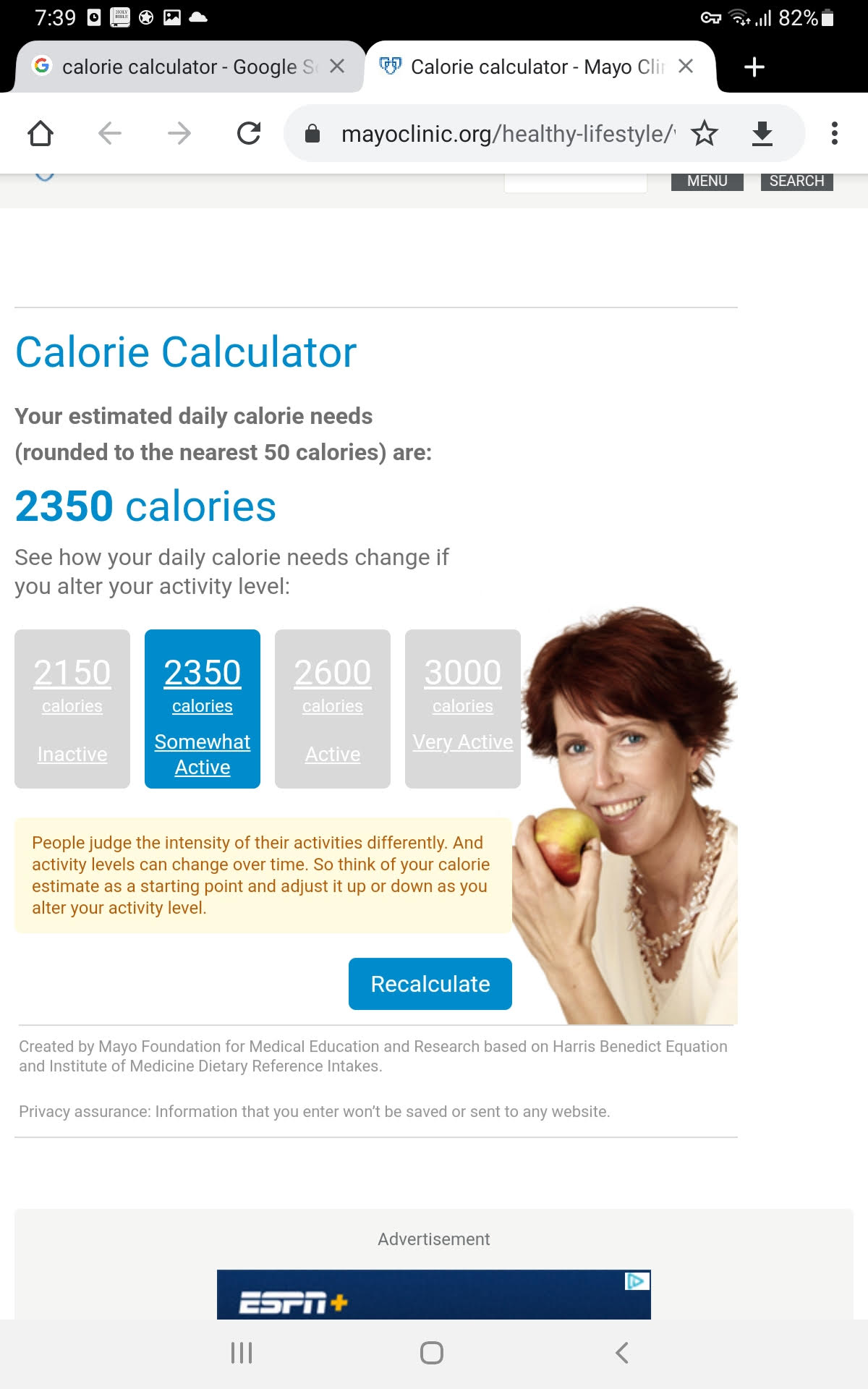
In order to learn how many calories your body needs each day you need to use a calory calculator like this one or this one. The following information needs to be inserted:
- age
- height
- weight
- sex
- exercise level
of calories you need each day in order to maintain your current weight. If you want to get bigger add more calories, if you want to lose weight (get shredded) take slightly less calories each day. The Bodybuilding.com calory counter will actually go that bit further and tell you exactly how many calories to take according to your goal.
Oats 300 + Peanut Butter 100 + Rasins 150 = 550
Lunch
Taco Salad 300 + Slice of Bread 100 = 400
Dinner
Burger 600 + Fries 350 = 950
Total = 550 + 400 + 950 = 1900
![]() |
As for how to know how many calories are in the food you eat. Currently, I just Google and have been keeping a list of everything. Another great way to do this is to download the My Fitness Pal app developed by Under Armour. After a while, you will be able to tell about how many calories are in your meal by looking at it, as you most likely eat the same things over and over again.
Friday, 11 June 2021
Principal's Principles #4
Welcome to the fourth installment of the blog series Principal's Principles. At this stage, I am completing my fifth year as an elementary school principal. The following are some of the learning that is taking place in my life during this stage.
Distribute Leadership
Plan like you are leaving! Anything can happen and you may have to leave your school tomorrow. One of the best things you can do is have a succession plan in place should that happen. This is done by developing a strong leadership team and distributing leadership as much as possible. Initially, as a new leader, you may feel insecure and that you want to be in the spotlight for every occasion. You need to get through this stage as soon as possible if you are in it.
Some practical ways to put this into practice are the following. Have lead teachers, coordinators or other key staff members lead assemblies. Distribute the load of planning and leading parent workshops throughout the year among the leadership team you have developed. Include a couple of people in your recruiting process. Teach them how to interview and call references. In particular, if you teach them to call references you are ensuring the safety of your students and the mental health of your current staff.
The Bus
Closely connected to the section above is the leadership saying: get the right people on the bus and get them in the right seats on the bus. This means that hiring is crucial. I have a saying, "I do not care about PYP or PhD, just give me a good teacher with a good attitude." I put much more weight in the reference calls than the interview. Through careful recruiting, you get the right people on the bus.
Developing a solid Professional Growth Program is then important to develop the people you have hired. I believe in promoting internally and developing the proven talent that you have. This is the second part of this saying, get them in the right seats on the bus. I suggest you promote internally and get competent people that you trust in lead teacher, coordinator, and other key positions.
Accreditation
This one is huge and has the potential to transform your organization. If you get your head around this it will be worth its weight in gold for you. I will most likely write a separate blog post about this. Accreditation agencies such as ACS WASC, CIS or NEASC have developed research-based standards over decades to guide schools. These standards form the basis of what makes a good school. Learn what they are inside out. I encourage you to apply to serve as a visiting team member with one of the above organizations. This will rapidly increase your learning in this area.
As you go through the accreditation process with your school, utilize it to its full. If the leadership team can really understand the value of an Appreciative Inquiry, Action Research, self-study process, it can transform the school. The action plan that is developed as part of this process should drive all you do at the school. This is particularly beneficial in times of crisis like the current COVID-19 pandemic that we are experiencing.
Professional Development
Align your professional development plan to your schoolwide action plan. Connect it to your teacher professional growth program. Ensure that you are not selecting PD on a whim with no follow-through. Plan it according to your action plan. For example, if one of your schoolwide goals is child protection then you should have child protection training as part of your PD program. Basically, it is a rule that the more you connect everything at the school, the faster you will bring about lasting change.
Baby Photos
My final bit of advice is to use baby photos. If it is a graduation, presentation, or whatever, if you put up pictures of your students when they were babies, it will immediately change the atmosphere in the room:-)
Thursday, 31 December 2020
The Big Bang and Christianity
I have recently been learning about Big Bang Cosmology and would like to document it. This means that at a point in the past space and time had a beginning. Some would say that the big bang is the greatest proof, of the 20th century that God is real and that the bible is accurate. Allow me to explain why.
Prior to the 1900s when the big bang was first theorized it was the belief of the majority of the scientific community that the universe was eternal. Here are examples of thinking throughout the ages.Bertrand Russell: The universe is just there. That’s all.
Aristotle: The idea of a first instant of time is inconceivable.
Epicurus: Truly this universe has always been such as it now is, and so it shall always be; for there is nothing into which it can change, and there is nothing outside the universe that can enter into it and bring about a change.
As a model of a cosmic beginning began to emerge the majority of scientists were opposed to it. Did you know that the term “big bang” was actually coined by Fred Hoyle in 1949 as a derogatory term as it did not align with his steady-state model?
Here are some other examples of the scientific community’s resistance to the big bang changing, which were shared by John Lennox, Professor of Mathematics at Oxford University (emeritus).
Hoyle proposed a ‘steady-state theory’ to explain the expansion.
John Gribbin (1976): Hoyle’s steady-state theory was given impetus by philosophers and theologians recognizing the problems and questions raised by the idea that the universe had a beginning.
Sir Bernard Lovell: Neither steady-state nor big bang cosmology offers a satisfactory explanation from science so they ‘must move over into metaphysics’ and postulate divine creation.
Lennox also notes that many scientists immediately saw how a cosmic beginning which the big bang theorized would only feed the argument for a creator God.
Christopher Isham - Perhaps the best argument that the Big Bang supports theism is the obvious unease with which it is greeted by some atheist physicists.
Stephen Hawking - Many people do not like the idea that time has a beginning, probably because it smacks of divine intervention.
What evidence do we have for a cosmic beginning? Also known as a space-time beginning or the big bang.
1920s - Alexander Friedman & George Lemaitre: Einstein’s theory of general relativity allows an expanding solution beginning with a singularity.
1929 – Edwin Hubble showed a red shift in spectra invisible light from other galaxies, the Doppler shift effect that indicated the universe was expanding.
1964 - Arno Penzias and Robert Wilson discovered cosmic background radiation, an omnidirectional signal in the microwave band. Their discovery provided substantial confirmation of the big-bang predictions by Alpher, Herman and Gamow around 1950. This basically proved that the universe was expanding and thus had a beginning that it was expanding from. In 1978 Penzias and Wilson were awarded the Nobel Prize in Physics for their work. (Taken from Wikipedia)
Here is a beautiful quote from Penzias, "The best data we have are precisely what I would have predicted had I nothing to go on but the five books of Moses, the Psalms, and the Bible as a whole". Do not be fooled into believing that Christianity and Science are at odds. If you are a believing scientist you are in good company along with the likes of Isaac Newton, Galileo Galilei, Francis Collins (who recently led the team to map the human genome), and these to name but a few.
And finally for the greatest proof for the big bang:
Genesis 1:1 - In the beginning, God created the heavens and the earth.
John 1:1-3 - In the beginning was the Word, and the Word was with God, and the Word was God. He was with God in the beginning. Through him all things were made; without him, nothing was made that has been made.
Sunday, 12 April 2020
Developing a Strong Marriage
What is worth learning? This is a question we often ask ourselves as educators. It has been my opinion for some time now that the three most important things are not taught in schools. These three things are budgeting, parenting, and marriage. I have been reflecting on what is worth learning during this current lockdown period. Many families are at home under quarantine and unfortunately, this can lead to conflict. In this post, I would like to share a tool to develop a strong marriage.
Communication
It is no secret that one of the keys to a strong marriage is communication. Carder (2008) writes, "A relationship needs lots of attention, or your perception of it will become outdated and you will have no clue about what is really happening between the two of you." In order to have a current correct perception of how your relationship is doing you may do the following activity.
Marriage Satisfaction Survey
The tool below is used to communicate with your spouse about your marriage. The sample in this image covers five years. You will need to create a sheet like this for every five years you have been living together. The steps are as follows:
- Together fill out the boxes at the bottom of the tool. There is a box for each six months.
- The boxes should include information such as; births, deaths, job status, moves, illnesses, marital difficulties, education, living arrangements and other major life events.
- Once you are finished make a copy of the tool.
- On your individual sheet plot a line on the rating scale going through the years of your marriage. Be honest, do not let your current feeling influence your decision. It should be how you felt at the time.
- To plot the line put a dot on the scale above each six month period. When you are finished, join the dots.
- Look for periods of high-level satisfaction reported by both of you (4-5).
- Talk about any surprises. Ask questions to understand why your spouse was feeling that at the time.
- Look at the overall pattern. Did you experience events with a similar pattern? Why or why not?
- Is there a decline in the pattern? Why is this?
- Was there a low point? How did you overcome this?
Sunday, 23 February 2020
Peak Immunity
With Ash Wednesday two days away, the old Catholic in me is thinking about what I will do for Lent. Living in China during the COVID-19, I am thinking about how can I improve my immune system. Being on lockdown due to the quarantine, I am getting out of shape. One way to kill all these birds with one stone is by doing a 40 day fast/diet, which I am going to coin a "faset".
I have done numerous diets, fasts and lifestyle changes over the years but the one I have found to be the most effective can be found in this book. I learned about Dr. Luc De Schepper from an amazing Natriopath called Allison Vidotto, back in 2006. I had a disease called Candida that was causing me to have Chronic Fatigue Syndrom. I had to sleep each lunchtime in my classroom and was in bits. After over a year of doctor visits that did not help, this faset cured me in just over two weeks. As I start this I weigh 178 lbs.
Week 1 - The Premise
The idea is to create the conditions in the body for peak immunity to be achieved. This is done by removing anything processed, with unnatural sugar, caffeine or anything that ferments. It incorporates the theory of food combining to create an optimal digestive system. The faset is extremely difficult and takes much planning and motivation to pull off. The results, however, are so good they are hard to describe. I hope to do that in Week 4. I am 178 lbs after Week 1.
Week 2 - The Pain
If this is your first time to do this faset or you have not done it in years, the pain will be terrible. The body gets a shock as it runs out of caffeine, sugar and all the other junk you have been giving it. This usually happens about three days in. This time both my wife and I are doing the faset. She has not done it in about 6 years, but I have done it more recently. We both had a bad headache around day two when our brains realized the caffeine was not going to come. This just lasted about a day, but my wife then started getting pains in her back and her neck. Her neck is actually stiff and has been frozen in position for the past couple of days. My skin is bad and there are spots appearing on my back. This is a sign of the toxins leaving. All I can say during this time is, stick it out. As it is about to get a whole lot better. Towards the end of Week 2, I started to feel foggy, sores appeared in my mouth and I felt like a sore throat was coming on. I weighed 174.5 lbs. Each day I was getting about 1500 calories which puts me very much in a deficit of my usual 2000. I would also like to note that I discovered a negative reaction to potato during Week 2 so I cut them out. With the high levels of starch in potato, I am surprised they are not on the forbidden list below.
Week 3 - The Food
Section 3 is taken directly from Full of Life by Dr. Luke De Schepper (p.164-167), as it is vital information to do the faset.
Fruits: Papaya, mango, kiwi, pineapple, banana, honeydew, melon, coconut, guava, grapefruit, berries and lemons. Eat in the morning at breakfast. Do not eat after meals. About 10% of patients will not be able to eat fruit at all because of the high fructose content (such as bananas) or because of high acidity (pineapples). CFIDS patients should eat fruit sparingly during the first four weeks of the program.
Juices: Water with lemon juice, fresh-squeezed vegetable juices, unsweetened cranberry juice, wheatgrass juice, fruit juices of allowed fruits (in moderation), coconut milk.
Grains: Brown rice, wild rice, millet, buckwheat, amaranth, quinoa, popcorn, corn tortillas, corn chips, "polenta", teff.
Brown Rice Derivatives: Mochi, brown rice syrup, rice cake, rice crackers, riz cous, creamy rice, "Rice and Shine", "Creamy Rice", brown rice cream (a hot cereal), rice dream beverages (almond, carob).
Beans and Legumes: All beans are allowed including garbanzos, hummus, lentils, black beans, pinto beans, etc.
Meats: Chicken, turkey, veal, lamb and rabbit.
Fish: The National Academy of Sciences and the U.S. Food and Drug Administration (FDA) report on low-and high-risk seafood varieties. Tuna generally has low levels of environmental contaminants. Cod pollock and haddock are found in deep offshore waters, also making them low in chemical contaminants. Ocean-caught salmon is notorious for parasites and should be fully cooked to destroy worms and amoebas, but is otherwise free of contaminants.
Canned tuna is rarely a cause of food-borne illness unless mishandled by food preparers. Beware of shrimp though because these scavengers of the sea are frequently mishandled in the store or in the home. As an extra precaution, consumers may want to reheat shrimp to destroy and possible bacteria or parasites. The greatest number of illnesses from finfish come from come from the tropical varieties, mahi-mahi, bluefish, barracuda, grouper and tropical snapper.
Freshwater fish from the Great Lakes, such as whitefish, from Santa Monica Bay, from Puget Sound and Chesapeake Bay may carry undesirable levels of chemical contaminants. Swordfish can carry elevated mercury levels and should be avoided, especially by women of child-bearing age.
The highest-risk seafoods are mollusks - oysters, clams and mussels - eaten raw. The intestines and viscera are the parts that we consume, and they contain all possible kinds of contamination, natural and man-made.
Dairy: Goat's milk, goat's cheese, goat's yogurt, butter and eggs. For those with high cholesterol levels, butter and eggs should be eaten only on an occasional basis. When you do this and leave out sugar and other foods on the "no" list, you will decrease your LDL (bad cholesterol) and increase your HDL (good cholesterol).
Oils:
Olive oil: use only organic cold-pressed, extra virgin olive oil. (So-called pure olive oil or virgin oil are second-rate)
Sunflower and safflower oils: chose the unrefined high-oleic varieties of these oils for cooking and baking.
Canola oil: the newest oil on the market is also the best. It contains linolenic acid, the Omega-3 fatty acid that reduces blood cholesterol levels and prevents clogging in the arteries.
Other oils allowed are avocado, sesame and flaxseed oil.
Nuts, seeds, nut butters and nut milks: (Store in freezer of refrigerator) All are allowed except peanut and pistachio products. No peanut butter! Nuts, seeds and nut butters should be eaten in moderate amounts, since they contain high amounts of calories, especially fats. For instance, one handful of cashews equals 750 calories. Keep in mind that roasted nuts are easier to digest than raw ones.
Vegetables: Steam of stir-fry all vegetables, avoid eating them raw. It is all right to have lettuce with fresh tomatoes and avocadoes and salad dressing consisting of an allowed oil with lemon juice. Sundried tomatoes are also allowed.
Seasonings, Spices, Herbs & Condiments
Quick Sip by Bernard Jenses (a tamari-like sauce)
Bragg's Liquid Aminos
Garlic, Onion, Sea salt (sparingly), dill, thyme, tarragon, rosemary, oregano, curry, basil, parsley, paprika, cinnamon, nutmeg, carob, etc.
Beverages
Pau D'Arco tea, water, water with lemon juice, peppermint and spearmint tea (excellent for digestion), Uvi Ursa tea (great for urinary tract symptoms and to help strengthen the bladder).
Other herbal teas (without caffeine) to be used sparingly. Watch out for either dryness or mold content, if they are stored for long periods of time.
Breads: Don't forget, bread has yeast and sugar, so you should avoid breads for the first four weeks of the eating program. Then incorporate them very slowly into your diet. Here are some breads you can choose:
Ponce whole rye (wheat and yeast free)
German sourbread (wheat and yeast free)
Rudolph's 100% rye bread with linseed (also wheat and yeast free)
No tomato or barbecue sauce (unless you make your own without peppers, sugar, vinegar, syrup).
Avoid raw and cold foods (except salads occasionally; more about salads is discussed later). Remember these foods decrease the strength of your digestive organ, the spleen-pancreas.
Absolutely no vinegar: in salad dressings, use mustard and mayonnaise.
No oatmeal, for at least four weeks.
No horseradish, peppers.
No canned foods or fried foods.
Avoid refrigerated left-overs, especially meat; freeze the leftovers and heat them up later (this is especially the rule for meats since they will become damp and moldy overnight).
Avoid ice in drinks.
(This section has been taken directly from p.164-166 of Full of Life.)
Week 4 - The Feeling
- Fruit should be eaten alone and on an empty stomach. Fruit should never be eaten after a meal as it digests much quicker than other foods. If it is eaten after meat for example which takes a long time to digest it gets stuck in the digestive tract and starts fermenting.
- Protein should not be eaten with starch. Eg. Do not eat steak with chips.
- Vegetables can be easily digested with anything except fruit.
![]() |
| Full of Life p.157 |
Week 5 - The Figuring Out
It is advised the on Week 5 you start to reintroduce foods every three days. This way you will see if you have any allergic reaction to the particular food. This may come in the form of an upset stomach, sore throat or evidence of a build-up of toxins. This also stops you from going crazy by going back on everything and getting sick. We reintroduced flour first so we could enjoy some bread, then three days later, which is today actually, we reintroduced cheese. Yum, cheese on toast. Next Tuesday we will reintroduce peanut butter and so on.
People who suffer with Candida (yeast overgrowth, which leads to chronic fatigue), should start to eat large amounts of garlic oil capsules during the last two weeks. This kills off the remaining yeast in your stomach. Take about six capsules with each meal. I am at 173.4 lbs after Week 5.
Week 6 -
During the final week of the fast, the body is operating at peak immunity. As new foods are introduced you get to see if you have any negative reactions to a specific food. For me, it became obvious that I have a reaction to potato. Being Irish, this is a death sentence:-)
Conclusion
Whatever diet or fast you pick be it paleo, vegan, vegetarian or this one, you will find that users share testimonies of their success. The common denominator in any of these diets is eating food in its purest form, be it meat, vegetables or rice. Each diet eliminates processed food. This particular faset is designed to build peak immunity, but you still receive the benefits as in any of the others.
Friday, 27 December 2019
Agency in the Early Years
This blog post documents the initiative taken by the early years teaching team at Xi'an Liangjiatan International School. Most of the team members along with me took part in professional development provided by Innovative Global Educators. During this PD we all got on the same page as to what are some best practices in early years education. We learned from some fabulous early years educators such as Anne VanDam and Fiona Zinn. The team also read the updated PYP documents to learn the philosophy behind student agency. The following paragraph is taken from The Learner, published by the International Baccalaureate Organisation.
When learners have agency, the role of the teacher and student changes; the relationship between a teacher and a student is viewed as a partnership. Students take initiative, express interest and wonderings, make choices and are aware of their learning goals. They are actively engaged and monitor and adjust their learning as needed. Students offer feedback to others and consult on decisions that affect them. In school, students take responsibility for their learning and collaborate with teachers and other students to plan, present and assess learning needs (2018).
The most important factor for this time to take place was a willingness for the teaching team to try new things. It is important that teachers have agency also to implement new initiatives. For this to happen the timetable needed to be created in a way that allowed for two periods of uninterrupted teaching time for all six classes. This was planned at the end of the academic year.
At the end of the school year I evaluated the effectiveness of the initiative by interviewing students and some of the staff who were involved. Below are some of their responses.
Students were asked if they liked agency time.
Student 1, "We go to other teacher's classrooms"
Conclusion
This year our early years team and I went to a REACH conference in Chengdu. REACH stands for Reggio Emilia in Asia for Children. We were very fortunate to learn from Claudia Giudici, president of Reggio Children. This conference further solidified for us the importance of play in the development of children and the value of agency.
Reggio Emelia in Asia for Children
Friday, 20 December 2019
Principal's Principles #3
I am ready for the third installment in my Principal's Principles series. Here are some more lessons I have learned in the course of my short four years as a school principal. I hope somebody is finding them useful.
No Pally Pally
As a school leader, it is important to be constantly learning. We can learn from mentors but we can also learn from mistakes others make. One thing I have learned that was not beneficial to school culture was when a school leader forms a clique with a group of teachers. This is usually around a drinking group or equivalent. This kind of social group can leave staff feeling excluded and can lead to favoritism. It is important for a school leader to be inclusive when organizing social events. I also suggest finding a social circle outside of the school community, this may be a sports team or church community. Having a social support structure in place is very important. Organizations such as EARCOS or ACAMIS can provide a vital support network for school leaders.
Communication
One of the most important things you can do is learn to communicate as efficiently and clearly as possible. There is no formula for this but blogs, emails and meetings are all means to do this. In a previous post, I mentioned emotional intelligence. Growth in this, as well as leadership and management, are vital. When an issue comes to you it is important that you do not get excited or react out of anger. This will be particularly difficult if you are sick, under tress or in pain. You need to know yourself. Quite often time can solve a situation without you even getting involved. It is a skill to learn when to get involved and when not to. A young or insecure leader will make the mistake of rushing in to establish their position and control. It can be equally damaging for a leader to shy away from the necessary tough talks. It is very important that you get all the information on any situation before acting. Take the time to interview the students or teachers involved. We use a reflection sheet to allow students to reflect on an issue. This serves as a way to immediately document the issue, which can be very helpful, later when parents may need to come in. If you have access to security cameras, get the facts.
![]() |
| Student Reflection Sheet |
Tough Talks
Never shy away from a tough talk when it is necessary. We practice restorative practices with both students and staff. If a relationship has been damaged or a school policy has been broken, it is important to be consistent with all staff. Minor incidents, of course, should be let go but leaders should be consistent with all staff and not shy away from though talks and the giving of feedback. If a staff member does not understand a policy or know what he has done wrong, he cannot make the change.
Code of Ethics
It is a good idea to create a code of ethics with your staff. One thing we have done is putting the following in place. It provides the opportunity for staff to take care of disputes themselves without needing to bring everything to leadership. When a dispute between staff occurs ensure step one has taken place before getting involved.
Step 1 - Staff members try to resolve the conflict by having a meeting and restorative conversation.
Step 2 - If the issue cannot be resolved the staff members make schedule a meeting with the principal.
Step 3 - If the issue cannot be resolved the staff members schedule a meeting with the head of school.
Big Announcements
Never announce something before it is official! Decisions can change. Do not make announcements before pen goes to paper.
Parent-Teacher Disputes
When a parent emails you with an issue relating to a teacher. Ensure that you direct the parent to communicate with the teacher directly for all normal day to day issues first. Never jump the gun and ensure you investigate thoroughly before acting. I recommend you email the parent back immediately to say you are looking into the issue then speak to everybody involved directly before either responding yourself, or supporting the teacher to respond. It is very important that you support your teaching staff. If you hired the person, it is your job to ensure they succeed to the best of your ability.
International School Community Reviews
If you are a school leader and you are making changes you will come up against resistance. You will have to make tough decisions that will not make everybody happy. Unless you are a people pleaser you can expect to have some bad reviews on the ISR site. Prepare for this in advance as it can hurt. You put years of your life into an organization and deal with things that teachers cannot even imagine. It hurts when you read a scathing review of yourself on this website. Getting feedback is very important. You should seek feedback, but from people who know you only.
Gossip Up
Encourage your staff to "gossip up". We introduce this concept during orientation. What this means is that if a teacher has an issue encourage them to bring it up the ladder vertically rather than horizontally, meaning they discuss it with peers. It may take a long time to implement this into a school but it is important for teachers to repeatedly know that you are available to speak about things.
Middle Leaders Professional Growth Program
Most schools have a solid process in place for teachers' professional growth. This is usually based on the work of Charlotte Danielson or James Stronge. However, an issue in many schools is that middle leaders are totally missed. It is important that these people have the opportunity to grow and receive feedback. They are in key positions and are often missed, particularly in developing international schools. There are lots of very good tools out there that form a great starting point for this. The Australian Standards for Principals contains some fabulous information on what school leaders should know, understand and do. It is a very good starting point for the development of your own tool.